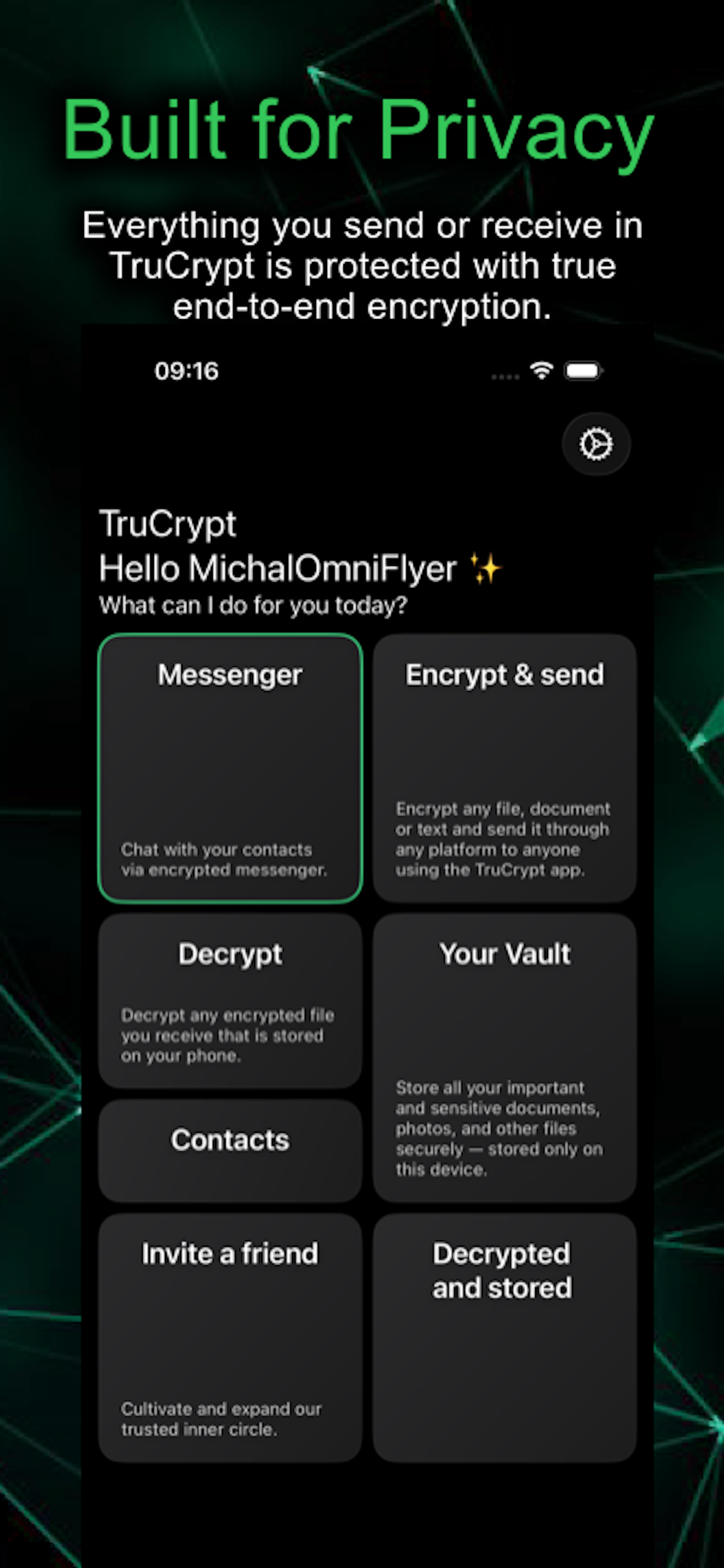
End-to-end encrypted messaging for iOS. RSA-3072 encryption, zero-knowledge architecture, and a clean UX for professional environments where security is non-negotiable.
The Problem
Security-conscious organisations need to communicate privately. Legal firms, financial services, executive teams. The problem isn't that no encrypted messaging apps exist. Most of them make the wrong tradeoffs: the UX is so poor people won't use it, or the security architecture still relies on trusting the server.
TruCrypt was commissioned to solve a specific, professional use case: encrypted messaging that people would actually deploy and use, with a security architecture that didn't require trusting the infrastructure provider.
Most "encrypted" messengers encrypt in transit but store plaintext or recoverable ciphertext on the server. If the server is compromised, so are the messages. Zero-knowledge design eliminates this attack surface.
Highly secure communication tools often have CLI interfaces, complex key management, or technical workflows that prevent adoption in non-technical teams. The technology has to work for normal users.
Enterprise deployment means handling user provisioning, key management workflows, and a clean onboarding experience that doesn't require users to understand cryptography.
The Solution
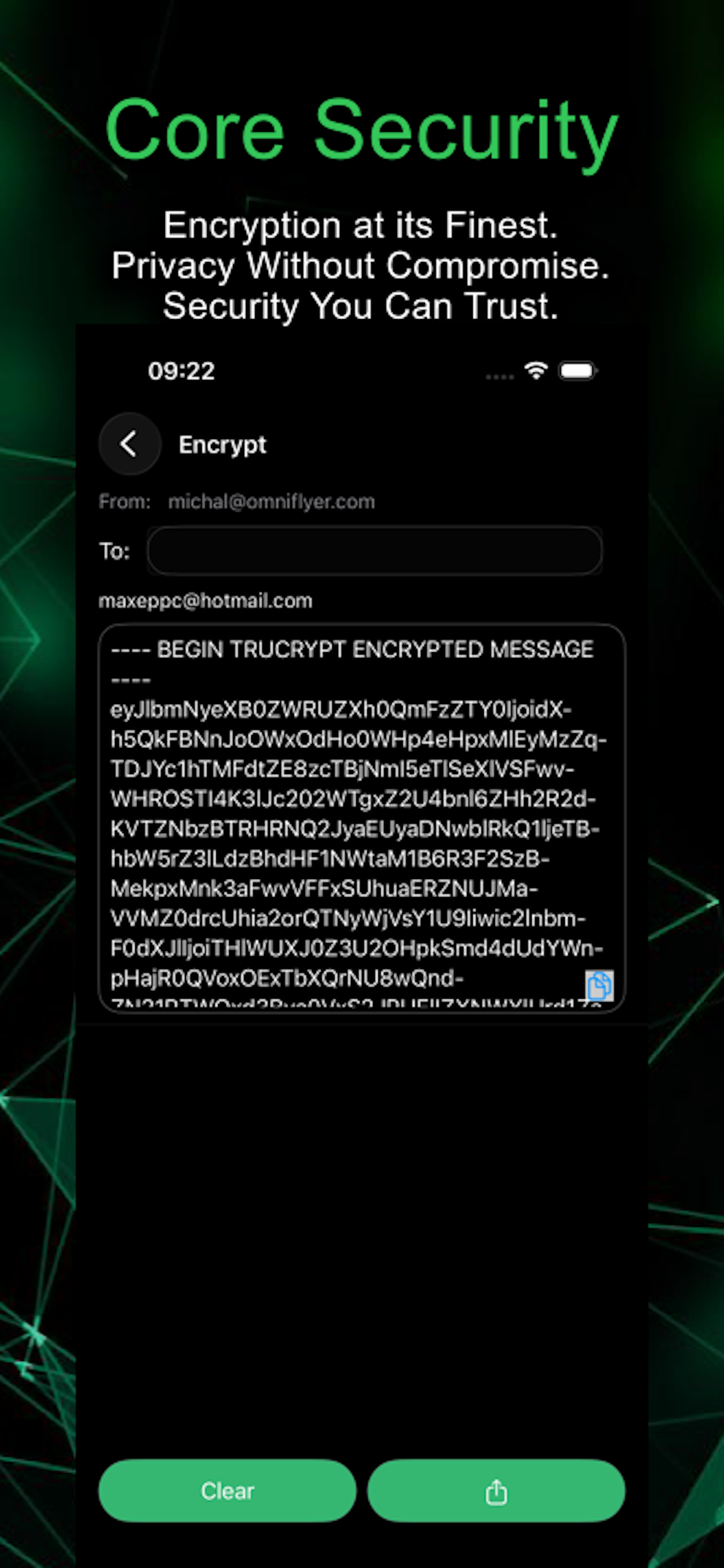
TruCrypt uses RSA-3072 asymmetric encryption. Messages are encrypted on-device before transmission, so the server never has access to plaintext. Even a full server compromise exposes only ciphertext that cannot be decrypted without private keys held on-device.
The engineering challenge was building this security model into a native iOS app that looks and feels like a normal messaging application. The cryptographic complexity is hidden below the UI layer. Users don't manage keys; the app does. They see a clean, fast messaging interface.
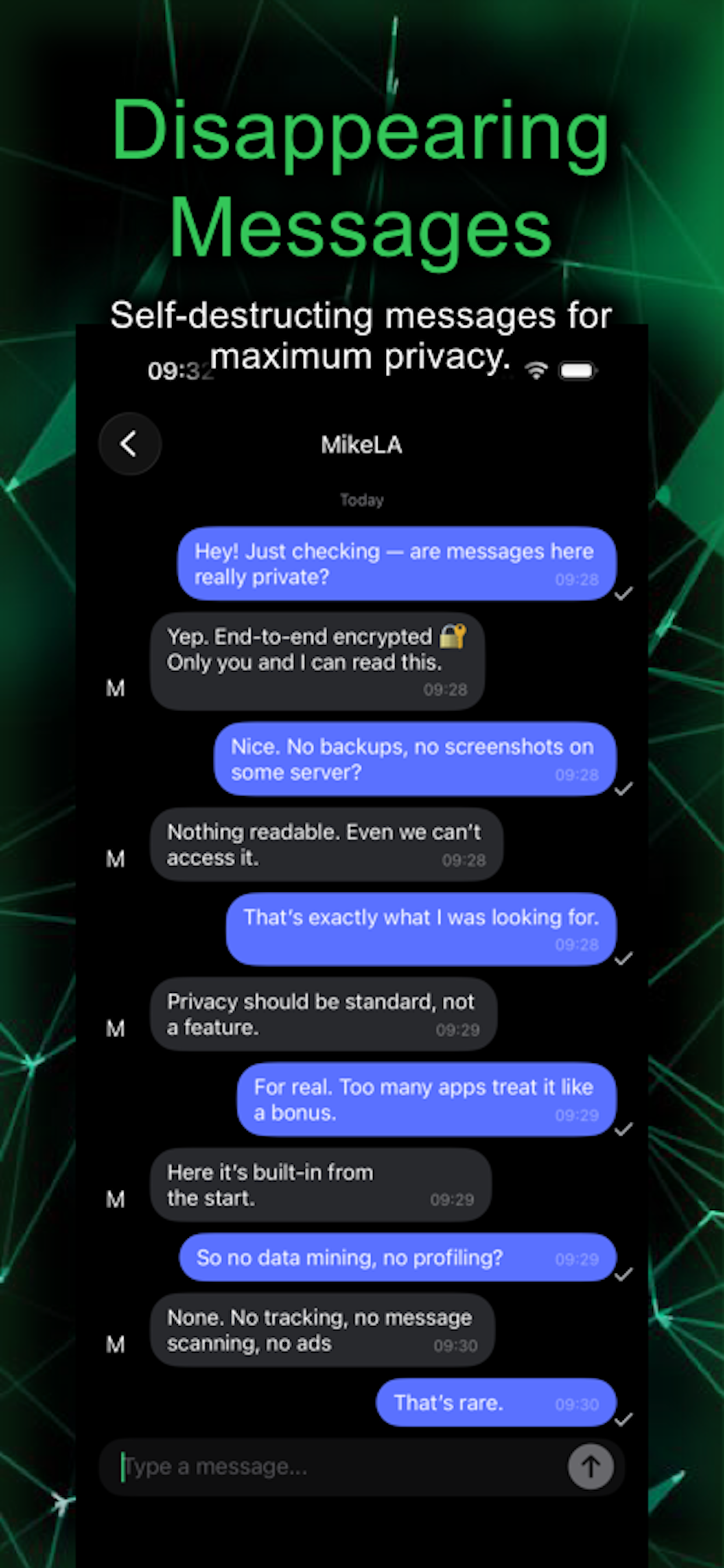
Disappearing messages, read receipts, and a professional contact management system make TruCrypt suitable for real deployment in professional environments.
"Michal brought exactly the right mix of technical depth and product thinking to TruCrypt. Building a security-first mobile app means there's no room for shortcuts. He got that from day one and delivered clean, solid work without needing to be managed. Rare to find an engineer who takes that kind of ownership."
Product
Under the Hood
Security engineering has unforgiving requirements. The architecture has to be correct, not good enough, not roughly right. Every component was designed with the threat model in mind.
RSA-3072 provides strong asymmetric encryption with a wide security margin. Key pairs are generated on-device at registration. The private key never leaves the device; the public key is shared for message encryption.
The server handles routing and storage of encrypted payloads only. It cannot decrypt messages. A server compromise exposes only ciphertext; without private keys, recovering plaintext is computationally infeasible.
Private keys are stored in the iOS Keychain with hardware-backed protection. Key generation, storage, and usage happen entirely on device. The user doesn't interact with key material directly.
Cryptographic operations are CPU-intensive. The iOS implementation uses native Security framework APIs and async processing to keep the UI responsive during encryption and decryption operations.
Configurable message timers with server-side and client-side enforcement. Expired messages are deleted from both the server and local device storage, with no recovery path.
Firebase handles message routing and push notifications. All data stored in Firestore is already encrypted at the app layer. Firebase sees only opaque blobs, consistent with zero-knowledge design.
My Role
TruCrypt was a client engagement where security was the core constraint, not an afterthought. The CEO's requirement from day one was no shortcuts. That meant understanding the cryptographic architecture before writing a single line of application code.
Working in this kind of environment requires a different mindset than typical product engineering. There's no "we'll handle that edge case later." Security assumptions don't have grace periods. The architecture has to be right before the feature is right.
Outcome
TruCrypt is live at gettrucrypt.com and available on the App Store. The product successfully deployed into professional environments and received strong validation from the client.
The CEO testimonial captures what good security engineering actually looks like from the product side: technical depth, no shortcuts, and the kind of ownership that doesn't require hand-holding.
Working on security-critical software changes how you think about engineering. Every assumption gets examined. Every edge case matters. That discipline carries over into everything built since.
Security is not something you bolt on at the end. I've built production systems where the security architecture came first. Let's talk.
Reach me at hello@skywaylabs.io